
Ultimate Guide to Visitor Management
Posted by Physical Security Gear on 8/27/2026
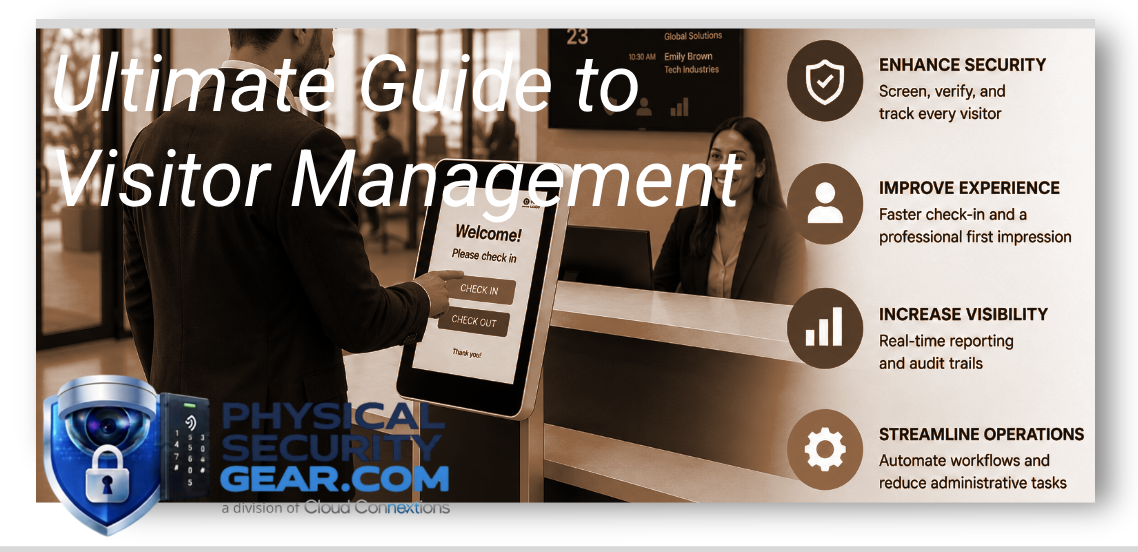
Why Your Front Desk May Be One of the Most Important Security Investments in Your Building
Executive Summary
Every organization has visitors.
Customers arrive for meetings. Vendors make deliveries. Contractors perform maintenance. Candidates interview for open positions. Family members visit employees. Executives welcome partners and investors.
For many organizations, those visitors are still managed with a clipboard, a paper sign-in sheet, or a receptionist trying to keep track of who's coming and going.
It feels simple because it's familiar.
Unfortunately, it's also one of the weakest points in many physical security programs.
Visitor management isn't about making people sign in.
It's about creating a professional experience while giving your organization better visibility, stronger security, and a more efficient way to manage everyone who enters your facility.
When designed properly, visitor management becomes more than a check-in process. It becomes part of how your organization protects people, supports compliance, and operates more efficiently every day.
Visitor Management Isn't About Visitors
It's about knowing who's in your building. That may sound obvious, but it's one of the first conversations we have with organizations evaluating visitor management. Most companies aren't looking for a digital sign-in sheet.
They're trying to answer questions like:
- Who is currently in the building?
- Has every visitor been approved?
- Which contractors have access today?
- Have required documents been completed?
- Can we quickly identify everyone on-site during an emergency?
Those are operational questions.
Visitor management simply becomes the platform that helps answer them.
The Front Desk Sets the Tone
For many visitors, the front desk creates their first impression of your organization.
A modern visitor management system creates a more consistent experience by allowing visitors to:
- Pre-register before arriving.
- Receive digital invitations and directions.
- Complete required agreements electronically.
- Notify hosts automatically upon arrival.
- Receive temporary credentials or badges.
- Check out when leaving the building.
The result is a smoother experience for visitors and significantly less administrative work for reception staff.
Good security should never create unnecessary friction.
It should make the experience feel organized, professional, and intentional.
Visitor Management Improves More Than Security
Organizations often begin looking at visitor management because they want tighter security.
What they usually discover is that it improves operations across multiple departments.
Common benefits include:
- Faster visitor check-in.
- Better visibility into building occupancy.
- Improved compliance and recordkeeping.
- Reduced manual paperwork.
- Automatic host notifications.
- Temporary credentials with defined expiration times.
- Better coordination with Facilities and Security teams.
The system becomes valuable because it simplifies everyday workflows while strengthening accountability.
What We See Most Often
One of the biggest surprises during planning is how inconsistent visitor processes have become over time.
Different offices use different sign-in procedures.
Contractors receive different instructions.
Receptionists develop their own methods.
Temporary badges are handed out without clear tracking.
Nothing is necessarily broken.
It has simply evolved over the years.
Implementing a modern visitor management platform gives organizations an opportunity to standardize those processes across every location, creating a better experience for visitors and a more consistent process for employees.
Visitor Management Works Best When It's Connected
Visitor management shouldn't operate independently from the rest of your security platform.
When integrated with access control and video surveillance, organizations gain a much clearer picture of what's happening throughout the facility.
For example:
- Visitors can receive temporary credentials automatically.
- Hosts are notified immediately upon arrival.
- Security teams can verify visitor activity with video footage.
- Temporary access expires automatically when a visit ends.
- Building occupancy becomes easier to monitor during emergencies.
These integrations reduce manual work while improving both security and operational efficiency.
Advisor's Note
One mistake we see organizations make is treating visitor management as a standalone purchase.
Instead, we encourage clients to think about the complete visitor journey.
How does someone schedule a visit?
How are they welcomed?
Who approves access?
How do they move through the building?
When does their access end?
Looking at the entire workflow often uncovers opportunities to simplify operations far beyond the front desk.
The goal isn't simply to modernize check-in.
It's to create a safer, more consistent experience for everyone entering your facility.
Questions We'd Ask Before Recommending a Visitor Management Platform
Before discussing products or software, we'd want to understand:
- How many visitors enter your facility each day?
- Do visitors require escorted access?
- Are contractors treated differently than guests?
- Do visitors need temporary credentials?
- Are compliance documents required before entry?
- Will visitor management integrate with access control or surveillance?
- Are multiple office locations involved?
The answers help determine which platform will best support your organization's workflows.
The Bottom Line
Visitor management isn't just another security application.
It's an opportunity to improve how your organization welcomes guests, manages risk, supports employees, and creates consistency across every facility.
The best systems don't simply record who entered the building.
They become part of a broader security strategy that integrates people, processes, and technology into a single, well-managed experience.
As your organization grows, visitor management should grow with it, supporting new offices, new workflows, and new expectations without adding unnecessary complexity.
Continue Your Research
As you continue planning your physical security strategy, these resources may also help:
- Ultimate Guide to Commercial Access Control
- Cloud Access Control Explained
- What Makes a Commercial Security Camera Different?
- How to Choose the Right Commercial Security Integrator
- Ultimate Guide to AI in Physical Security