
How Much Does Commercial Access Control Cost?
Posted by Physical Security Gear on 8/22/2026
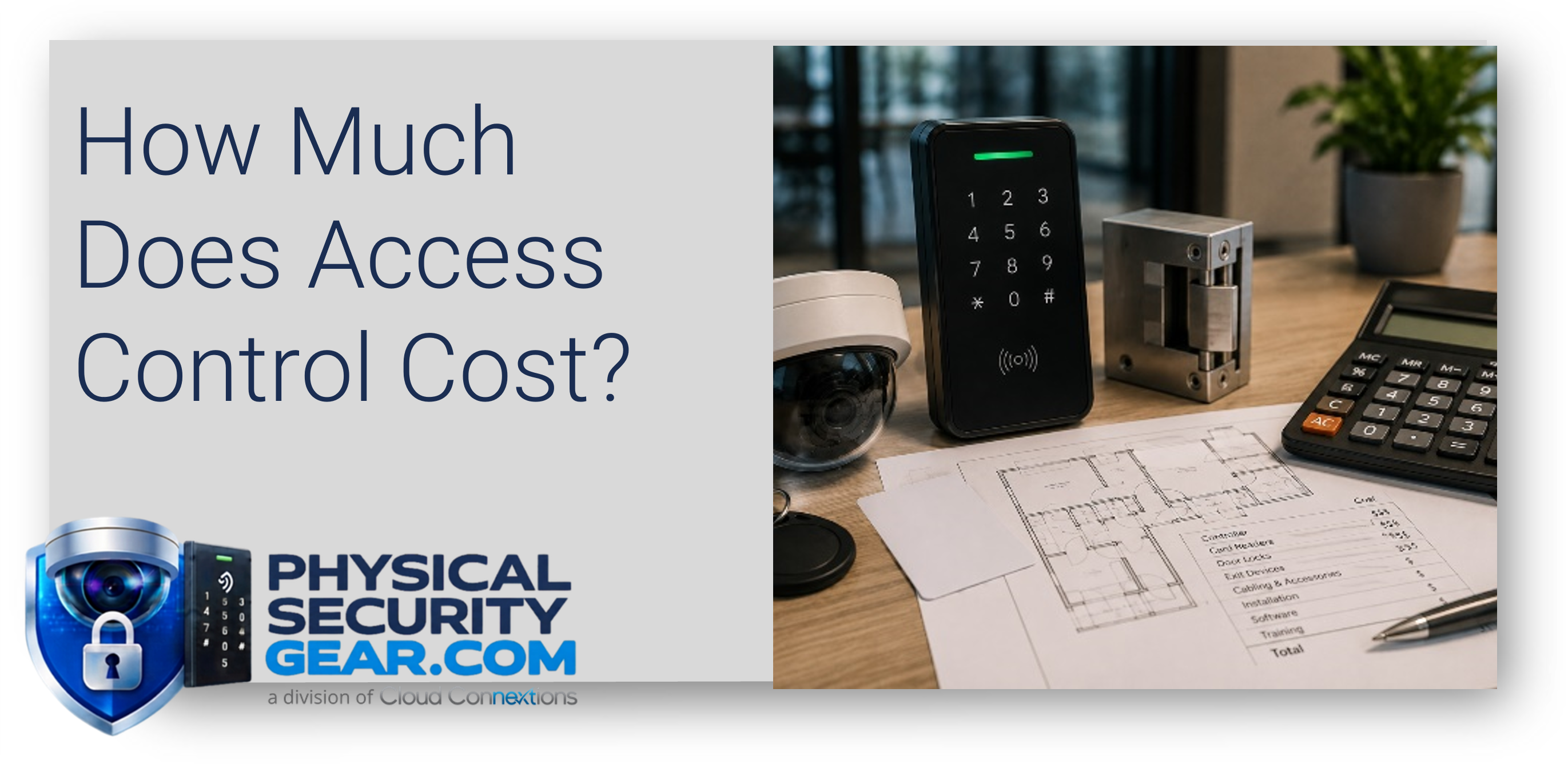
A Practical Guide to Budgeting for an Access Control System
Executive Summary
One of the first questions we hear when an organization begins planning an access control project is also the most reasonable.
"What is this going to cost?"
The honest answer is that a door count alone usually isn't enough to provide an accurate number.
Two organizations may each need access control on four doors and end up with very different projects. The existing door hardware, credential strategy, software platform, network infrastructure, installation requirements, integrations, and condition of the building all influence the final investment.
That doesn't mean you can't build a realistic budget.
It simply means the best budgets are built around understanding your environment instead of guessing based on a number of doors.
Our goal is to help you understand what actually drives cost, where organizations often underestimate their investment, and how proper planning can save both time and money as your business grows.
Start With the Doors, But Don't Stop There
The number of controlled openings is one of the first things we ask because every secured door introduces equipment, installation, and programming requirements.
However, not every door is created equal.
A standard interior office door may require one solution.
A storefront entrance may require another.
An emergency exit, warehouse door, gate, or all-glass entry can each require different hardware and installation methods.
That's why a question like:
"We have four doors. How much will it cost?"
is really just the beginning of the conversation.
The better question is:
"What type of doors do we have, how are they used, and what outcome are we trying to achieve?"
Every Door Is Different
One of the biggest misconceptions in commercial access control is that every opening uses the same hardware.
In reality, selecting the correct locking hardware is one of the most important parts of designing a reliable system.
For many projects, electric strikes are one of the most cost-effective solutions. They work well on many commercial doors and allow organizations to modernize access control without replacing the entire locking assembly.
Unfortunately, they aren't the right answer for every opening.
For example:
- Full-glass storefront doors often require magnetic locks.
- Emergency exits may require electrified panic hardware.
- Aluminum storefront doors, steel doors, wood doors, and fire-rated openings each have different installation considerations.
- Existing door frames, locking mechanisms, and local building codes all influence the final recommendation.
Two buildings with the same number of doors can have very different project costs simply because the doors themselves require different solutions.
This is one of the biggest reasons we recommend a site assessment before finalizing a proposal.
What Are You Actually Paying For?
Most commercial access control projects include far more than readers mounted next to a door.
A complete system may include:
- Door controllers
- Card or mobile credential readers
- Electronic locking hardware
- Request-to-exit devices
- Door position sensors
- Network equipment
- Software licensing
- Programming and configuration
- Professional installation
- Testing and commissioning
- Administrator training
- Ongoing software support
When comparing proposals, it's important to understand exactly what's included.
Two quotes may appear similar until you realize one includes installation, programming, training, and licensing while another only includes hardware.
A Real-World Example
To help put these numbers into perspective, here's a recent project we designed for a client securing four commercial doors.
The solution included:
- Four-door cloud-managed access control platform
- Four multi-technology card readers
- Electric strikes on each opening
- Exit hardware and door monitoring
- Cloud software licensing
- Programming and system configuration
- Professional installation by our certified integration team
The complete first-year investment was just over $30,000, including equipment, licensing, programming, installation, and project implementation.
At first glance, some organizations are surprised by that number.
After walking through everything included, the conversation usually changes.
They're no longer comparing the price of a card reader.
They're evaluating the investment required to design, install, configure, support, and maintain a commercial security platform that will likely serve the business for many years.
Adding Video Verification
Many organizations decide to install security cameras at the same time they deploy access control.
Why?
Because access events become significantly more valuable when they're paired with video.
Instead of simply seeing that an employee badge opened a door, security teams can also verify who actually entered, review activity surrounding the event, and use AI-powered search tools to investigate incidents much more efficiently.
For the same four-door project, adding commercial security cameras at each entrance increased the first-year investment to approximately $40,000.
That additional investment included:
- Commercial AI-enabled security cameras
- Camera licensing
- Installation
- System integration
- Analytics supporting facial verification and event investigation
For many organizations, the additional visibility is well worth the investment because access control and surveillance become one integrated security platform instead of two independent systems.
Planning for Visitor Access
Another enhancement many organizations consider is adding a cloud-managed video intercom.
Some businesses choose to implement it during the initial deployment.
Others build the infrastructure now and add the intercom later as their operational needs evolve.
For the same project, adding a commercial video intercom increased the first-year investment by approximately $2,500.
The result gives employees the ability to:
- Visually verify visitors before unlocking the door.
- Speak with guests remotely.
- Manage deliveries more efficiently.
- Improve security after normal business hours.
- Create a more professional visitor experience.
Like many technology decisions, it comes down to operational priorities rather than simply adding another device.
Once the Project Is Properly Defined, We Can Estimate a Per-Door Cost
One question we hear frequently is:
"Can you just tell me what it costs per door?"
The answer is yes, but only after we've taken the time to understand the project.
Once we know the platform you've selected, the type of door hardware at each opening, your credential strategy, installation requirements, and any planned integrations, we can typically establish a realistic per-door investment for your organization.
That becomes extremely valuable for businesses planning future expansion.
If you're securing four doors today but expect to build another office next year, occupy another floor, or standardize multiple locations over time, having an established per-door cost makes future budgeting much more predictable.
Instead of starting from scratch with every project, leadership can estimate future phases with a much higher degree of confidence.
The important thing to remember is that the per-door cost is specific to your environment, not a universal industry average.
Once the foundation has been properly designed, expanding becomes significantly easier because you've already standardized the hardware, software platform, installation approach, and operational workflows.
This is one of the biggest long-term advantages of investing the time to design the system correctly from the beginning.
What We See Most Often
One of the biggest shifts we see during discovery meetings is that projects rarely stay limited to the original request.
A customer may begin by asking for access control on four doors.
As we learn more about their environment, we discover opportunities to:
- Standardize multiple office locations.
- Replace physical keys with mobile credentials.
- Improve visitor management.
- Integrate video surveillance.
- Simplify employee onboarding and offboarding.
- Reduce the amount of time IT spends managing security.
Those aren't upsell opportunities.
They're opportunities to solve related operational challenges while the project is already being planned.
Our philosophy has always been simple:
Solve today's problem while building the right foundation for tomorrow.
Advisor's Note
The organizations that get the most value from their investment aren't necessarily the ones with the largest budgets.
They're the ones that spend time understanding their workflows before selecting hardware.
The right platform, the right door hardware, and the right implementation strategy create consistency that makes every future expansion easier.
Whether you're adding one more door or opening another office across the country, building a repeatable standard saves time, reduces complexity, and creates a much better ownership experience.
The Bottom Line
There isn't a universal price for commercial access control because there isn't a universal commercial building.
Your investment depends on the doors you're securing, the hardware those doors require, the software platform you choose, how your employees will use the system, and how your organization plans to grow.
The best projects don't begin with equipment.
They begin with understanding your business.
Once those pieces are understood, building an accurate budget becomes much simpler, and creating a scalable security standard for future offices becomes one of the greatest long-term returns on your investment.
Planning an access control project? Start by gathering your approximate door count, photos of your existing doors and hardware, the number of users, and any future expansion plans. We can help you evaluate your options, build a realistic budget, and design a solution that fits the way your organization operates today while preparing you for tomorrow.